Key takeaway
SEO isn't measured by Googling one phrase. Your site ranks for hundreds of searches, at positions that shift daily, so one spot-check tells you nothing. Open Search Console and watch organic impressions and clicks over months. If both are climbing, your SEO is working, even if you're not first for the phrase in your head.
Here's a conversation we have almost every week. Someone Googles one phrase, the exact thing they think their customers type, sees they're not number one, and the heart sinks. "I thought our SEO was working. We're not even on the first page for this."
We get it. It feels like the obvious test. You search the main thing you sell plus your town, and if you're not top of Google, the SEO must be failing.
Except that's like judging your whole month's takings by one customer's invoice. It tells you almost nothing, and it has you worrying about the wrong things. So here's how SEO is actually measured, with real Search Console data from sites we manage.
You don't rank for one keyword. You rank for hundreds.
This is the bit nearly everyone misses. Your website isn't trying to rank for the one phrase in your head. It's ranking for everything people type that's even loosely related to what you do:
- Your main service, and your service plus your town
- "How much does [your service] cost"
- "[Your service] near me"
- "Best [your service] in [your area]"
- "[Your service] reviews", and a few hundred more variations besides
Some of those you'll rank top three for. Some you'll be on page two for. Some you'll be sitting at position fifty for, and you'd never know unless you went looking.
Here's a real example from one of the Search Console accounts we manage. Over the last three months Google recorded this site appearing for 150 different search terms, at positions from number one all the way down to ninety-eighth. That's completely normal. That's what every real SEO campaign looks like under the bonnet.
So when someone asks "are we ranking?", there isn't a single answer. You're ranking brilliantly for some things and not at all for others, all at the same time.
Why your "average position" looks worse than it is
Google Search Console will show you an average position across all your keywords, and this number trips people up constantly.
On that same site, the average position over the last three months is 20.8. At a glance that sounds rubbish, page two-ish. But averages lie when the spread is wide.
The site is first for several terms and around fiftieth for competitive ones it's only recently started chasing. Blend those together and you get 20.8, even though the reality is "winning some, building others".
It's like working out the average age of a room with a newborn and a pensioner in it and concluding everyone's middle-aged. Technically true, tells you nothing.
This is exactly why a new keyword you start targeting can drag your average down even when everything is going right. You enter ten new competitive terms at position sixty and your tidy average gets worse, because you're now visible for things you weren't visible for at all before. That's progress showing up as a worse-looking number.

Real Search Console data from a site we manage. That "20.8" average position is a blend of keywords ranking anywhere from #1 to #98, which is why no single number tells the whole story.
Rankings move every single day
Even for one keyword, there is no fixed "position". Google re-shuffles results constantly based on who's searching, where they are, what device they're on, what they searched a minute ago, and a thousand other signals.
You can be third in the morning and seventh by the afternoon for the same phrase, without anything on your site changing. Search from the office and from home and you'll often get different results.
So if you check a keyword on Tuesday, panic, and find you've "dropped" by Friday, you haven't necessarily done anything wrong. That's the daily weather of search.
Daily traffic does the same thing. Here's the overview from another site we manage. Clicks jump around day to day, quiet stretches then sudden spikes. None of that is the site getting better or worse overnight. It's noise.

Another site we manage. Up top, daily clicks bounce around constantly. Ignore any single day. Underneath, the number of pages Google has indexed climbs steadily to 27: the site getting healthier where it counts.
That's the single biggest reason not to measure SEO by spot-checking one phrase. You're taking one reading, of one keyword, on one day, on one device.
So how do you measure SEO properly?
You stop looking at individual rankings and look at the two numbers that actually tell the story, both inside Google Search Console: impressions and clicks.
Impressions = how many times your site showed up in Google's results, whether anyone clicked or not. It's a direct measure of how visible you are across all those hundreds of keywords at once.
Clicks = how many of those people actually clicked through to your site.
Here's the crucial part most people don't realise: these are organic numbers. Search Console only counts visits from someone typing a search into Google and clicking your result. It doesn't count your Instagram, a link you sent in a text, your email signature, or people typing your web address straight in.
Every impression and click in here is a stranger who found you on Google because of your SEO. That's what makes it the honest scoreboard: it can't be padded out by your social media or by people who already knew you. (We've written a step-by-step guide on how to track your SEO performance if you want to check your own.)
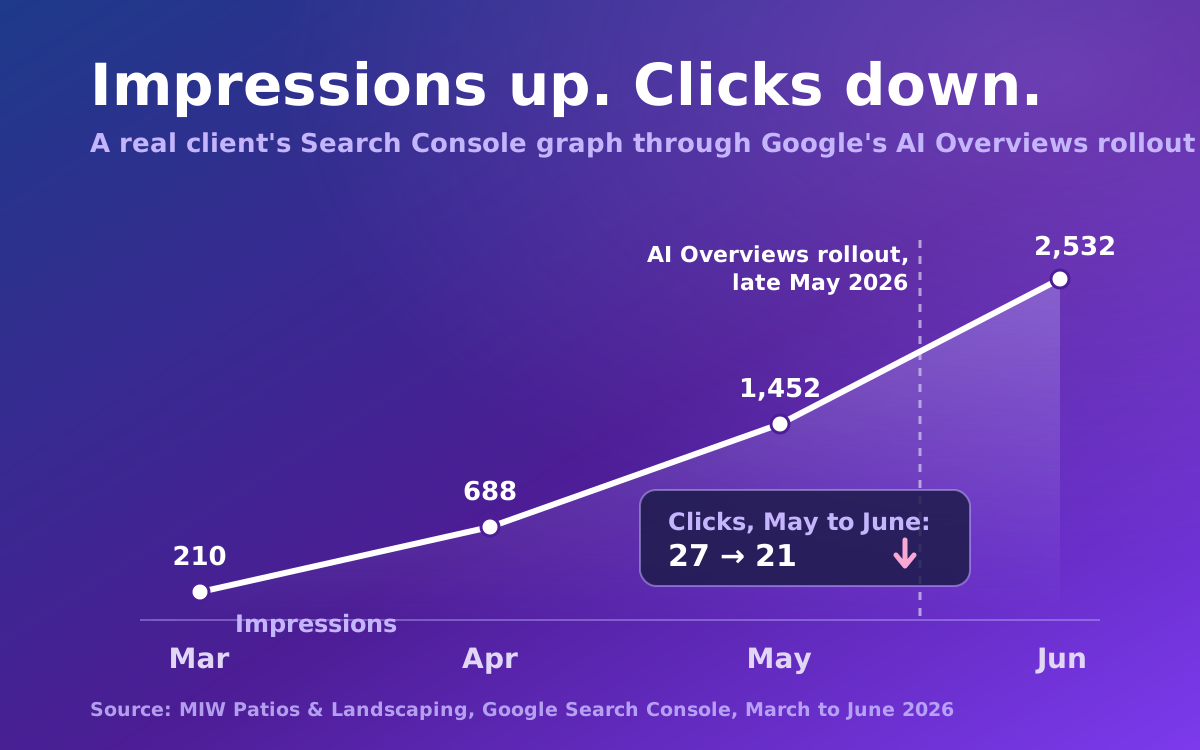
What you want is both of those lines climbing over months. More impressions means you're visible for more searches, and higher up. More clicks means that visibility is turning into actual visitors. When both are trending up, your SEO is working. Full stop. That's the measurement, not where you sit for one phrase on one Tuesday.
What working SEO actually looks like over time
Here's the chart you really want to see, from one of the sites we manage. Forget any single day. Step back to the monthly view and you get the trend that matters: organic impressions and organic clicks both climbing, month after month.

A site we manage, viewed month by month. Impressions (purple) and clicks (blue) both heading steadily up and to the right. This is what working SEO looks like: not a single position, but a trend pointing the right way.
Notice we're not pointing at a ranking. We're pointing at the direction of travel: more people finding this business through Google every month, none of them from socials, direct, or people who already knew them. That's the whole game, and a one-off Google search can never show it.
Why isn't a new site just number one for everything?
Because two things decide where you land for any given search: how competitive that keyword is, and how much authority your site has earned.
Some searches are brutal. The most contested terms in your trade might be held by firms who've been trading twenty years, with hundreds of reviews and years of other websites linking to them. A six-month-old site doesn't leapfrog that overnight, and anyone who promises it will is selling you a fantasy.
Other searches are far less contested, and a good new site can rank for those quickly.
Authority is the bit you build over time. It comes from pages properly built around what people search, a well-optimised Google Business Profile, genuine reviews, and other reputable sites linking to you.
It's the slow, compounding work of local SEO. The more you've earned, the higher you rank across the board, and the more of those competitive keywords start falling your way. The work done in month one is still paying off in month twelve, and the gap between you and slower competitors widens the longer you keep at it.
The honest version of "are we ranking?"
So next time you're tempted to Google one phrase and judge everything by it, don't. Open Search Console instead and ask three better questions:
- Are my organic impressions going up over time? (Am I getting more visible?)
- Are my organic clicks going up over time? (Is that visibility bringing real visitors?)
- Is the trend over months pointing in the right direction? (Ignore any single day.)
If those are climbing, your SEO is doing its job, even if you're not number one for the one phrase stuck in your head. And you never will be number one for everything. Nobody is. You'll be first for some things, fighting for others, and quietly hoovering up traffic across hundreds of searches you've never even thought to check.
That's not a campaign falling short. That's exactly what good SEO looks like.
Want us to look at your actual numbers? We'll pull up your Search Console, show you what's really happening across all your keywords, and tell you straight where the opportunities are, on a quick call. Book a free call here.