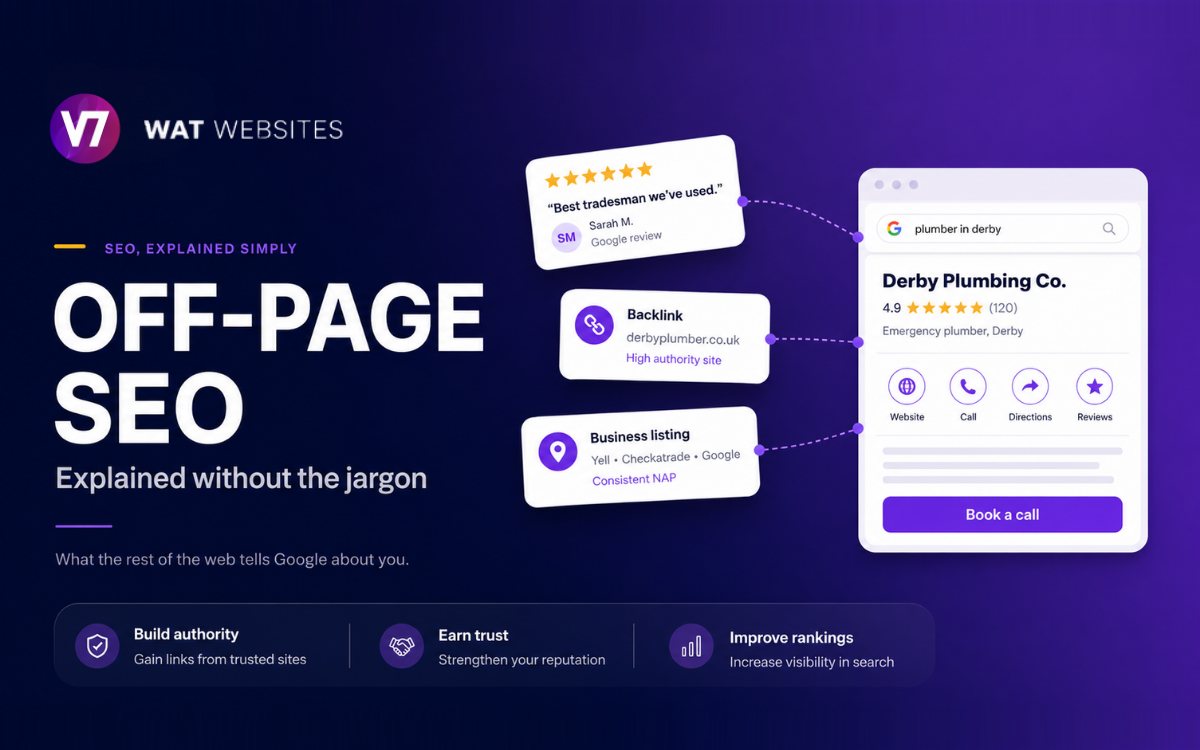
Key takeaway
Off-page SEO is everything that builds your reputation away from your own website: backlinks, local citations, reviews and your Google Business Profile. For a local business, consistent citations, an active Google Business Profile and real reviews matter far more than buying links by the hundred.
Open your spam folder and there's a good chance you'll find one: "I can get your website 50 high-authority backlinks this month." Off-page SEO attracts more cold emails, jargon and outright nonsense than any other part of SEO. It's also genuinely important, once you strip away the sales patter and do the bits that count.
So here it is in plain English: what off-page SEO is, how it differs from on-page, which parts are worth your time as a local business, and which parts are a great way to waste money or get penalised.
On-page vs off-page: the quick version
On-page SEO is everything on your own website that you control directly: page titles, written content, headings, images, how fast the site loads. If you can log in and change it, it's on-page. (Here's our plain-English guide to what on-page SEO is.)
Off-page SEO is the opposite: everything on the rest of the web that tells Google your business is real, trusted and worth showing. Links from other sites, directory listings, your reviews, your Google Business Profile. You don't control it directly; you earn it.
On-page is what you say about yourself. Off-page is what everyone else says about you. And if your real question is which one to do first, we've answered that separately.
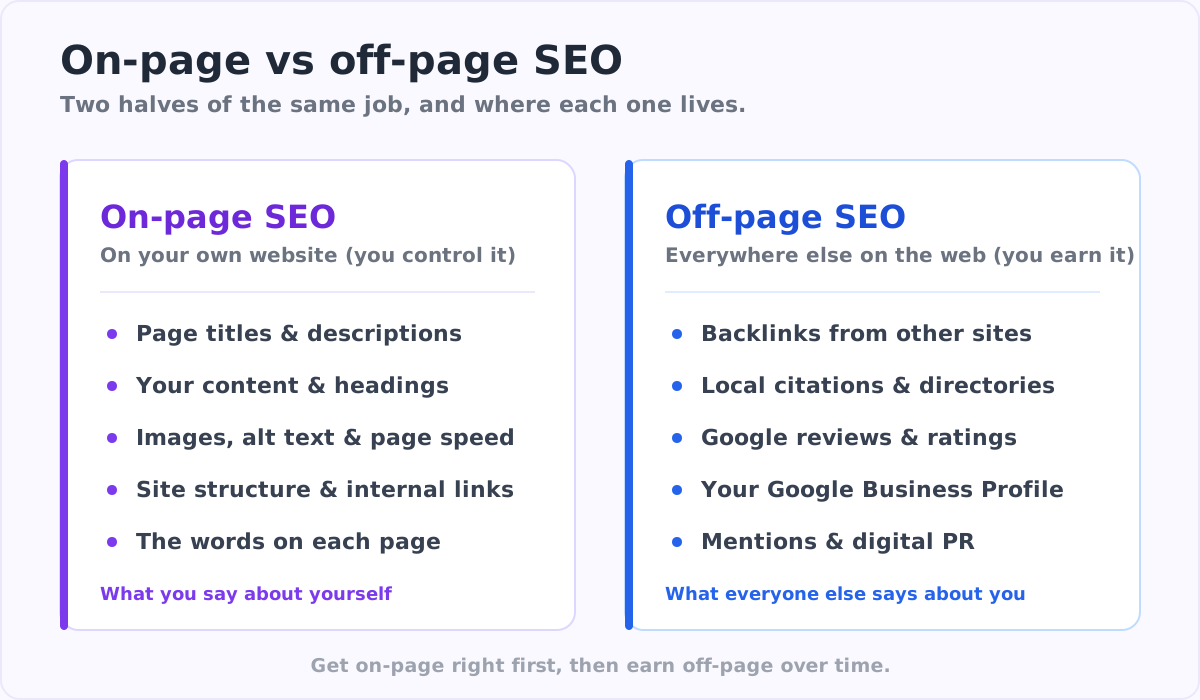
Same idea, side by side:
| On-page SEO | Off-page SEO | |
|---|---|---|
| Where it lives | On your own website | The rest of the web |
| Who controls it | You do, directly | You earn it over time |
| Examples | Titles, content, structure, page speed | Backlinks, citations, reviews, your Google Business Profile |
| In a nutshell | What you say about yourself | What everyone else says about you |
So what actually counts as off-page SEO?
For a local service business, it comes down to three things. Here they are in order of how much they'll move the needle, which is almost the reverse of how much the cold emails talk about them.
1. Citations (the quiet workhorse for local businesses)
A citation is any place online that lists your business name, address and phone number, your "NAP" for short. Think Yell, Checkatrade, your trade directories, local listing sites. Nobody clicks most of them, but Google uses them to confirm you're a genuine business operating where you say you are.
Here's what one looks like: your details, sitting on someone else's website.
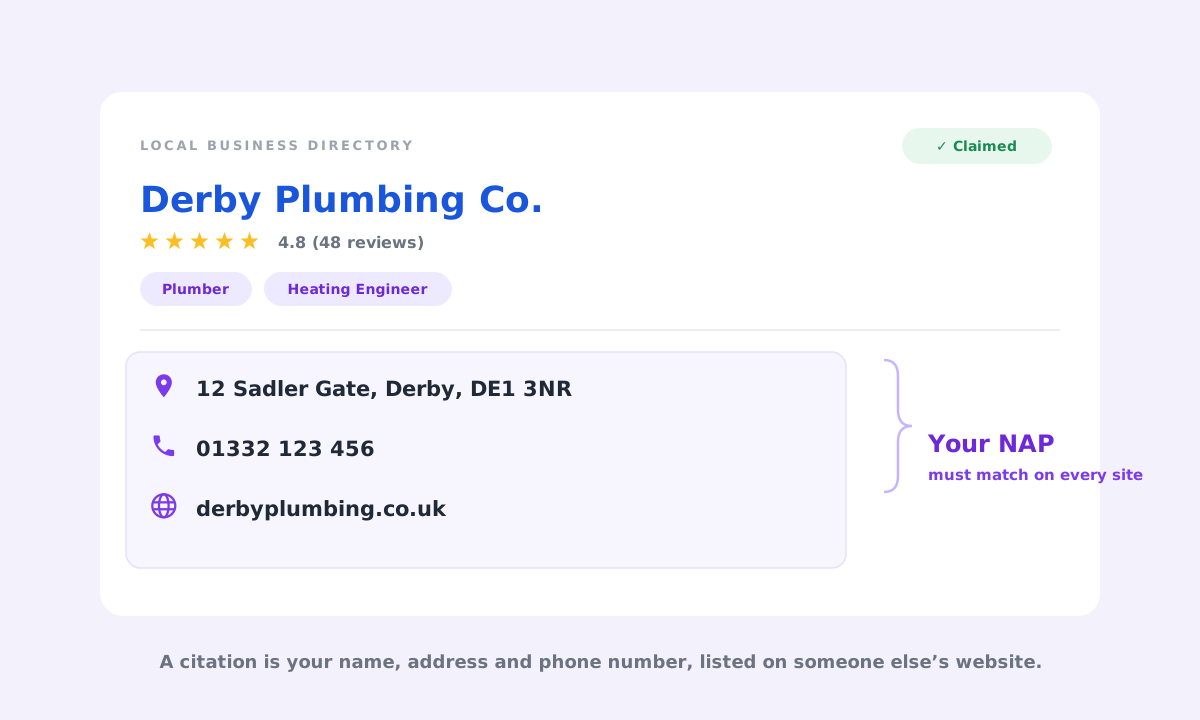
The key word is consistent. Same name, same address, same phone number on every one. If half the web has your old mobile number and the other half your landline, that quietly works against you.
Here are three real citations we set up for one of our clients, Nottingham Landscaping Services: the same name, phone number and website listed identically on Cylex, Houzz and ProvenExpert.

Citations are mostly a one-off job, not a treadmill. Get listed on the sites that matter, make every detail match, then leave them be. If you want to make a start today, these three are free and worth having:
- Cylex UK: a big, well-indexed UK business directory
- Yell: the UK's best-known listings site
- FreeIndex: free to list and popular with UK trades
Add Bing Places while you're there (Bing's version of a Google Business Profile) and you're already ahead of most local competitors.
2. Your Google Business Profile and reviews (the biggest lever most people ignore)
For anyone selling locally, this is arguably the most valuable off-page asset you have, and it costs nothing. Your Google Business Profile is what feeds the map pack, the box of three local businesses at the top of local searches. (Here's how to get into that map pack, verification nightmares and all.)
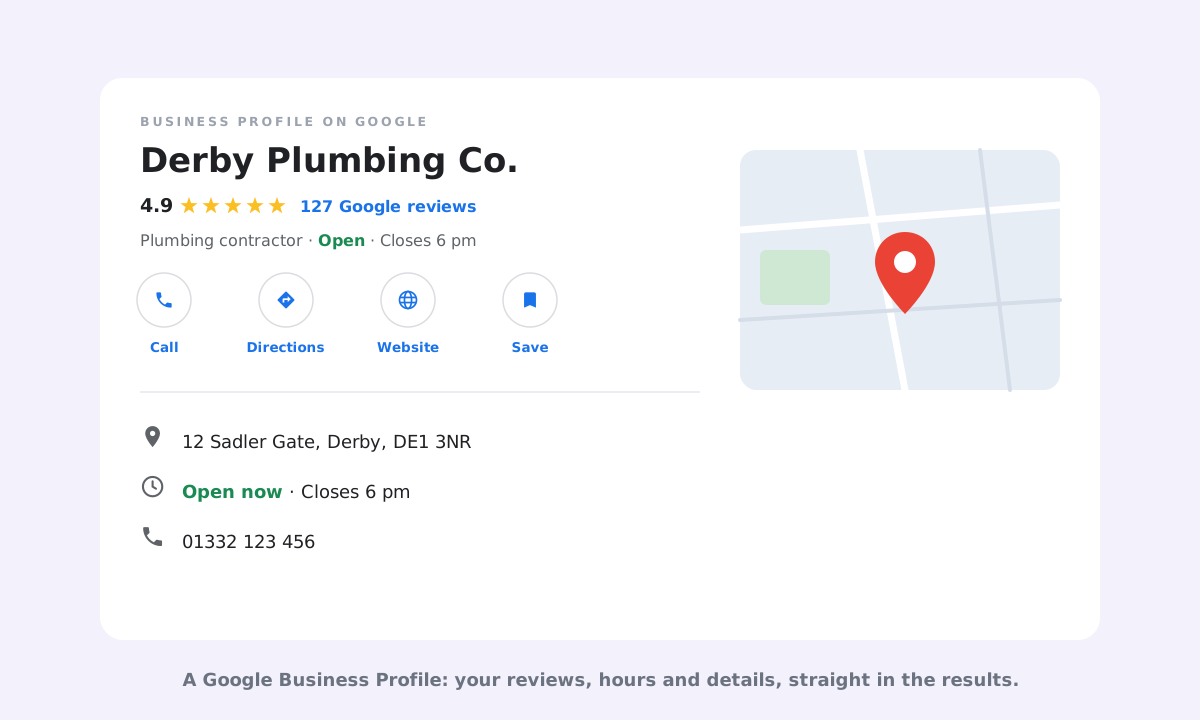
Reviews are a huge part of how Google decides who goes in that box, and they're pure off-page signal: real customers, on Google's own platform, vouching for you. A steady trickle of genuine reviews will usually do more for a local plumber or landscaper than any link-building package.
That's why we build a review system into the sites we manage, so asking for reviews stops being the thing you always mean to do and never get round to.
3. Backlinks (the famous one, and the most abused)
A backlink is a link from another website to yours. Google's ranking system was built on the idea that a link is a recommendation: if trustworthy sites link to you, you're probably worth trusting too. That's still broadly how it works.
The catch is that not all links are equal, and this is where the cold-email industry preys on people. One genuine link from a local news site, a supplier, a trade body or a real business in your area is worth more than 500 links from sites that exist purely to sell links.
Quality and relevance beat volume every time. A good off-page SEO approach earns a small number of real links slowly. It doesn't buy a job lot overnight.
The stuff to run away from
Off-page SEO happens off your own site, so it's the easiest place to cut corners and the easiest place to get burned. Steer clear of anything that promises:
- A set number of links for a flat fee ("50 backlinks for £10")
- "Guaranteed DA50 links" or similar authority-score promises
- Private blog networks (PBNs), link farms, or "link exchanges" at scale
Google has spent over a decade getting good at spotting bought links, and its spam policies explicitly target link schemes. At best these tactics do nothing. At worst they earn you a manual penalty that's a genuine pain to recover from.
Why off-page matters most once your on-page is sorted
Get your on-page right first. There's no point earning links to a page that doesn't clearly say what you do or where you do it.
Once your site is solid, off-page becomes the tiebreaker. When ten local firms all have a decent website, Google leans on off-page signals (who's got the reviews, the citations, the mentions) to decide the running order.
It's also the part of search holding up best as AI Overviews change how results look. The map pack and local results, powered by your Google Business Profile and reviews, is where AI has disturbed things least.
What we actually do (and what you can do yourself)
None of this is secret. On the sites we manage, the off-page work is unglamorous and steady: keep the Google Business Profile complete and active, keep citations consistent, make asking for reviews automatic, publish content worth linking to, and earn a handful of real, relevant links over time.
Then we judge it on impressions and enquiries, not a vanity "authority score". (Here's how SEO is actually measured.)
If you'd rather do it yourself, start with the free wins: claim and complete your Google Business Profile, get your name, address and phone number identical everywhere, and set up a repeatable way to ask happy customers for a review. That alone puts you ahead of most local competitors.
The honest summary
Off-page SEO is Google reading what the rest of the internet says about your business. For a local service firm, the parts that matter are the least exciting: consistent citations, an active Google Business Profile, steady real reviews, and a few genuine links, roughly in that order.
Ignore anyone selling backlinks by the hundred. Do the boring things well and you'll quietly outrank the businesses chasing shortcuts.
Frequently asked questions
What is off-page SEO in simple terms?
Off-page SEO is everything that happens away from your own website that tells Google you are a real, trusted business worth showing. That mainly means links from other sites, listings in directories (citations), your Google reviews, and your Google Business Profile. On-page SEO is what you put on your site; off-page SEO is what the rest of the web says about you.
Is off-page SEO the same as link building?
Link building is part of off-page SEO, but not all of it. Earning links from other websites is one off-page signal, but citations, reviews and your Google Business Profile matter too, and for a local business they often matter more than links. Treating off-page SEO as just buying some backlinks is exactly the mistake that gets people burned.
Do backlinks still work in 2026?
Genuine ones do. A link from a real, relevant website still acts as a recommendation that Google pays attention to. What no longer works, and can actively hurt you, is buying links in bulk or using link farms and private blog networks. Google's spam policies target those schemes directly, so a few real links beat hundreds of fake ones.
How is off-page SEO different from on-page SEO?
On-page SEO is everything on your own website that you can edit: titles, content, headings, images and page speed. Off-page SEO is everything on the rest of the web that influences how Google sees you: links, citations, reviews and your Google Business Profile. You control on-page directly; off-page you earn over time.
Can off-page SEO hurt my rankings?
It can, if you cut corners. Buying large numbers of low-quality links, using private blog networks, or spamming directories can trigger a Google penalty that is slow and awkward to recover from. Done properly, with consistent citations, real reviews and a small number of genuine links, off-page SEO only helps.
Does a small local business really need off-page SEO?
Yes, though probably not in the way the cold emails suggest. For most local businesses the off-page work that pays off is unglamorous: an active Google Business Profile, consistent listings, and a steady flow of genuine reviews. Get those right before you spend a penny on link building.
Not sure where your off-page SEO stands? We'll take a look at your Google Business Profile, your citations and your current links, and tell you straight what's worth doing and what to ignore, in plain English. Book a free call here.