On this page
- ChatGPT often searches before it writes
- Check ChatGPT's crawler can actually reach you
- What Google says, in Google's own words
- For a local business, your website usually isn't the only source
- Write pages worth quoting, starting with things only you know
- How to check whether ChatGPT names you
- How to measure it, and the bit nobody mentions
- The honest summary
- FAQs
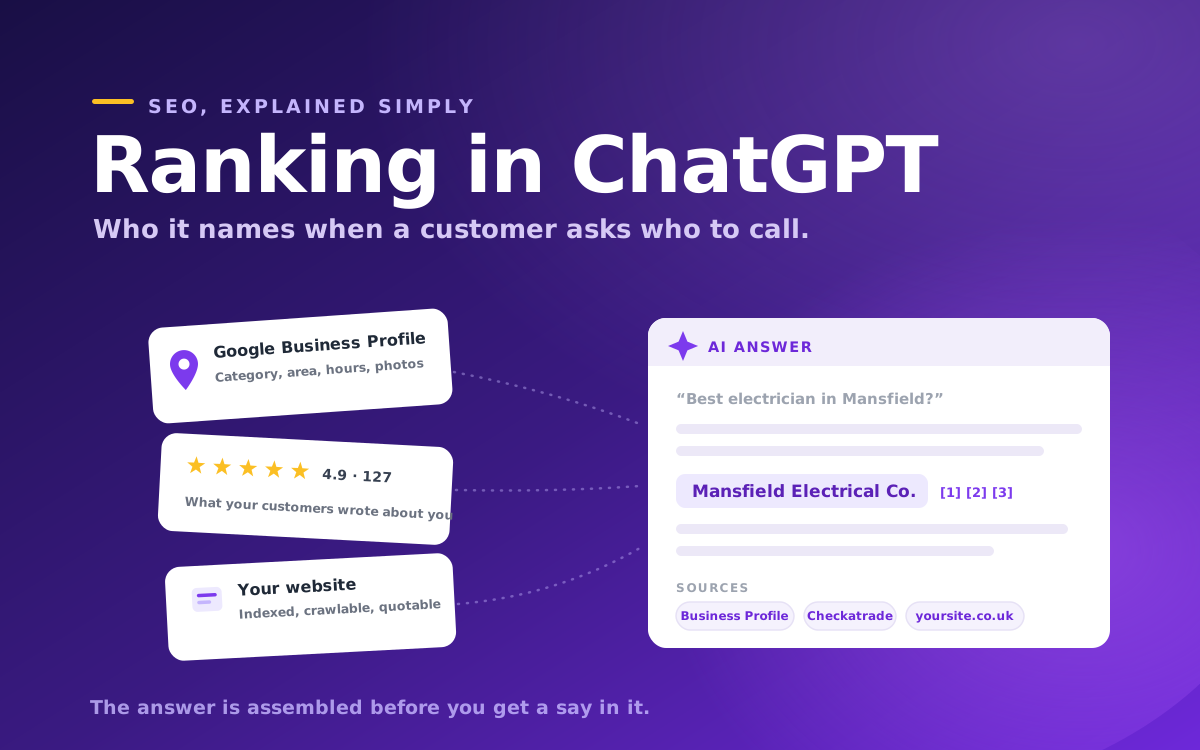
A few of our clients have asked the same question this year. Their customers have stopped typing "electrician near me" into Google and started asking ChatGPT who to call. So how do you get ChatGPT to say your name?
First, a correction. There is no ChatGPT ranking. Ask the same question twice and you can get two different sets of businesses, because it ran two different searches. What you're actually trying to do is be one of the sources it finds and repeats.
Second, there's now a whole industry selling answers to this. AI SEO packages, "generative engine optimisation", special files you're told to upload so the robots can read your site. Most of it is nonsense, and you don't have to take my word for that.
OpenAI and Google both publish how this works. Below, I've labelled what the documentation says, what's reasonable inference, and what we've seen on our own site.
ChatGPT often searches before it writes
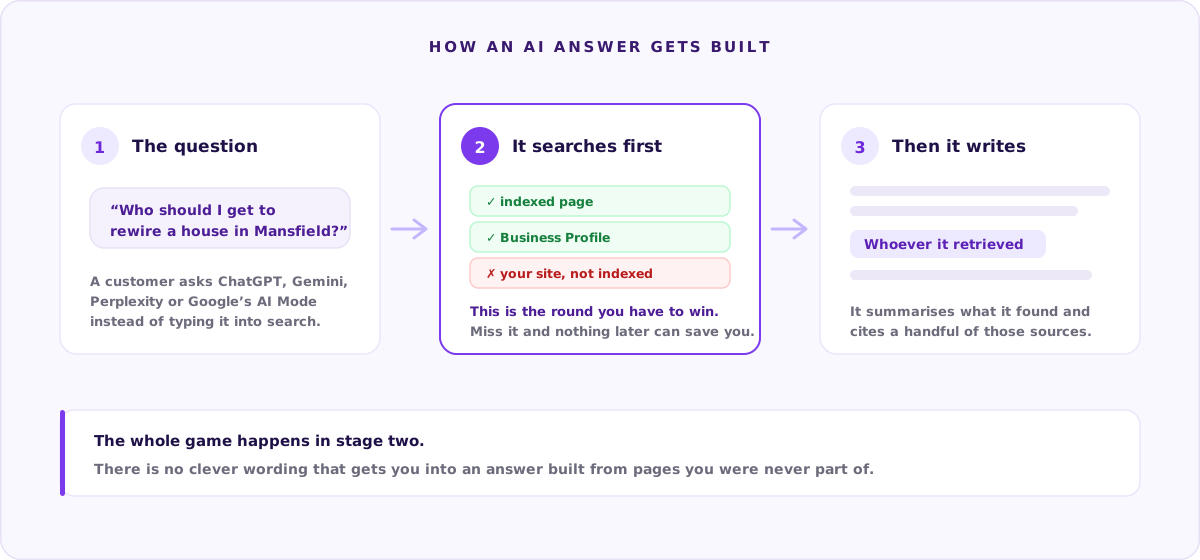
What the documentation says. ChatGPT doesn't search every time. OpenAI's position is that it searches the web when a question might benefit from current information. "Who should I get to rewire a house in Mansfield" triggers a search. "What is a consumer unit" may be answered from what the model already knows.
So there are two rounds: retrieval, then writing. Almost everything sold as "AI optimisation" is aimed at the writing round. But you can't be summarised out of a set of pages you weren't retrieved into. That's why the advice below looks so much like ordinary SEO. Being findable is the strategy.
Check ChatGPT's crawler can actually reach you
Here's the one genuinely new job, and it takes about ten minutes. Each AI search product runs a named crawler, and your robots.txt file decides which ones get in. Most site owners have never looked. Some have been handed a "bot protection" setting by a hosting company or plugin that quietly blocked the lot.
The names matter, because they do different jobs. Blocking the one that trains models is a legitimate choice. Blocking the one that puts you in results is self-harm.
| Crawler | Run by | What it does | If you block it |
|---|---|---|---|
| OAI-SearchBot | OpenAI | Surfaces sites in ChatGPT's search features | You won't be shown in ChatGPT search answers, though you can still appear as a navigational link |
| GPTBot | OpenAI | Crawls content that may be used to train OpenAI's models | Your content isn't used for training. ChatGPT search is unaffected |
| ChatGPT-User | OpenAI | Fetches a page when a user asks ChatGPT to look at it | Limited effect, as user-initiated fetches may not follow robots.txt |
| Googlebot | Crawls for Google Search | Google can't crawl the page, which effectively destroys its useful Search and AI visibility | |
| Google-Extended | Controls use of your content for Gemini and other generative products | Gemini is affected. Your Search and AI Overviews eligibility is not | |
| PerplexityBot | Perplexity | Surfaces and links sites in Perplexity results | You stop appearing as a Perplexity source |
| Perplexity-User | Perplexity | Fetches pages when a user asks it to | Limited effect, as it generally ignores robots.txt |
Sources for that table are OpenAI's crawler documentation and Perplexity's bot documentation.
The bit to hold onto: GPTBot and Google-Extended are about training. OAI-SearchBot and PerplexityBot are about being found. Plenty of businesses have blocked the lot to keep their content out of AI training, then wondered why they never get cited. Those are different goals, and you have to pick.
To check your own site, type your domain followed by /robots.txt into a browser, so yourbusiness.co.uk/robots.txt. If you see Disallow: / under any of the bots above, that's your answer.
No robots.txt at all doesn't mean nothing is blocked. A CDN, firewall or bot-management service can refuse these crawlers before robots.txt is ever read, and Cloudflare and similar services often do it by default.
OpenAI's own recommendation is to allow OAI-SearchBot in robots.txt and allow its published IP ranges at the network layer. That second part is the bit most people miss.
What Google says, in Google's own words
Google publishes a page on how sites appear in AI Overviews and AI Mode, and it's refreshingly blunt. A page must be indexed and eligible to show a snippet in Google Search. That's the bar. No additional requirements, no special optimisations.
There's now a separate switch, and the UK got it first
This changed in June 2026. Search Console now has a Search generative AI control under Settings: include your content in Google's generative AI features, or exclude it. Inclusion is the default.
It's a grounding control, not a ranking one. Google says it "isn't used as a ranking or inclusion signal affecting other parts of Search", so excluding yourself doesn't damage normal rankings. It rolled out to UK properties first and is still reaching a subset of owners, so it may not be in your account yet.
For almost every service business the right setting is the default. But check nobody has flipped it on your behalf.
The llms.txt question, settled
You may have been told to add an llms.txt file, a plain-text summary of your site supposedly written for language models. Google's AI features documentation settles it in one line: "You don't need to create new machine readable files, AI text files, or markup to appear in these features."
The same page says there's "no special schema.org structured data that you need to add" either. Adding an llms.txt is harmless. Paying someone for it is not. If it's a line item on your quote, ask what else on that quote was chosen the same way.
For a local business, your website usually isn't the only source
What the documentation says. OpenAI describes ChatGPT Search as using web search along with trusted third-party providers for things like nearby business listings. It doesn't say ChatGPT reads Google's map pack, or how it picks a local business.
What we've seen. Ask ChatGPT "who's the best electrician in Mansfield" and the sources it cites are frequently not company homepages. In the checks we've run for clients, directories, review platforms and third-party listings keep appearing alongside, and often ahead of, the businesses' own sites. That's observation, not a study, and anyone claiming to know the formula is guessing.
Why it's plausible anyway. "Best" is a judgement, and your own website isn't a credible source on that. A tool assembling an answer goes where other people have said something about you.
So the practical list is the one you should be doing anyway:
- A complete, verified Google Business Profile with the right primary category and the areas you cover. Google recommends keeping it current for its own AI features too
- A real, growing pile of genuine Google reviews
- Consistent name, address and phone details across your directory listings, which is the off-page SEO job
None of that is new. It's local SEO, the same work that wins the map pack, and it already mattered most. What's changed is that your reputation is now read, summarised and repeated to someone who never visits any of those pages.
Write pages worth quoting, starting with things only you know
Your own site matters for the other half of the questions. Not "who's the best" but "how much does a rewire cost" or "how long does a resin driveway take to cure". Those get answered from content, and that content can be yours.
If you do one thing beyond the robots check, do this. Google's guidance comes back to helpful, people-first content and warns off content built for machines. For a trade, that means first-hand material nobody else can publish:
- Real figures from jobs you've actually completed, not a range copied off another site
- Before and after photos of your own work, with what the problem turned out to be
- The complications specific to your area: Victorian terraces, clay soil, a council that's fussy about dropped kerbs
- Actual timescales, including the bits that go wrong and what that adds
- Why you'd recommend one approach over another, in the words you'd use on someone's doorstep
Every generic "5 signs you need a rewire" article already exists a thousand times over. A page about the job you did in a specific street, with the real cost and the thing you found behind the plasterboard, is something only you can have. And it's better content whether or not any of this AI stuff pans out.
Formatting, honestly labelled
The usual advice is to answer the question directly under the heading, phrase headings the way people ask, and put comparisons in tables and lists. I do all of that, because it makes the page clearer for a human.
I can't find anything from OpenAI or Google showing AI tools lift the first sentence under an H2 or prefer tables. Treat it as good writing, not a trick.
Three technical points that are real:
- Keep the answer in the HTML. If your content only appears after JavaScript runs, some crawlers won't see it. Worth checking on any page-builder site
- Use schema markup as ordinary SEO, not an AI unlock. LocalBusiness markup still helps Google understand your business details
- FAQ markup no longer earns you anything in Google Search. Google retired FAQ rich results in 2026. Keeping it does no harm, but don't pay for it as a Search win
How to check whether ChatGPT names you
There's no rank tracker for this I'd trust yet, so do it by hand. Twenty minutes a quarter.
Write down the five questions a customer would genuinely ask before hiring you. Ask each one, word for word, in ChatGPT. Note which businesses get named and which sources get cited. Repeat in Gemini, Perplexity and Google's AI Mode if you want the fuller picture.
You'll learn whether you appear at all, who your real competition is (often not who you assumed), and which sources these tools trust for your trade. That last one tells you which listing or review platform to go and fix.
Four things that will ruin the test:
- Ask each question several times. You're looking for who shows up consistently, not who appeared once
- Use a clean session. OpenAI notes that saved memory and personalisation can change how your question gets rewritten into searches
- Check your location setting. Yours is probably set to where you are, not where your customers are
- Write down the date. A result without a date is close to useless six months later
Do it again in three months. That comparison beats any AI visibility dashboard you'll be sold this year.
How to measure it, and the bit nobody mentions
Google: you can now isolate AI impressions
On 3 June 2026 Google launched Search generative AI performance reports in Search Console. You get AI impressions, broken down by page, country, device and date. You don't get clicks, queries or click-through rate, at least at launch. Anyone showing you AI-specific query or CTR data from Search Console is showing you something Google doesn't publish yet.
ChatGPT: the tracking is built in
ChatGPT automatically adds utm_source=chatgpt.com to referral links from ChatGPT search, so publishers can spot that traffic. It's documented in OpenAI's publishers and developers FAQ.
In GA4, filter Session source for chatgpt.com, or just read the AI Assistant default channel group, which buckets ChatGPT, Gemini and Claude for you.
What it looks like on our own site
In the 90 days to 14 August 2026, watwebsites.co.uk had 1,736 sessions. 45 came from chatgpt.com, about 2.6%. Every session GA4 filed under AI Assistant came from ChatGPT. Nothing from Perplexity, Gemini, Copilot or Claude registered at all.
So it's small. Anyone telling a plumber to reorganise their marketing around AI search this year is ahead of the evidence. It's also concentrated: for this site, ChatGPT was the AI channel, so if you only check one tool, that's the one.
The caution: we sell websites and SEO, so our visitors are far likelier to use ChatGPT than someone hunting an emergency plumber at 9pm. Don't read our 2.6% as yours. Go and look at your own AI Assistant channel. It takes a minute.
The gap nobody sells you a fix for
When ChatGPT names your business and the customer rings you straight off the back of it, nothing lands in your analytics. No referral, no UTM, no session. Worth knowing before you judge this channel on numbers alone, and worth asking new enquiries where they heard about you.
We wrote about the wider shift, with real Search Console data from a client, in Google's AI Overviews are eating clicks. Short version: impressions up, clicks down, and the businesses that only ever counted clicks are the ones panicking.
The honest summary
Check nothing blocks OAI-SearchBot, in your firewall as well as your robots.txt. That's the one job unique to this. Google says plainly there are no special AI optimisations, no magic files and no special schema. Then put your effort into your Google Business Profile, your reviews, your listings, and content built on jobs you've actually done.
It's the SEO you should already be doing, done properly, plus one file check, and almost all of it pays off in ordinary search anyway. The reason to bother now is that the businesses quoted in these answers are being recommended rather than listed.
Frequently Asked Questions
How do I get my website to show up in ChatGPT?
Start by checking nothing blocks OAI-SearchBot, the crawler OpenAI uses to surface sites inside ChatGPT's search features. That means your robots.txt and also your firewall, CDN or bot protection, which can refuse a crawler before robots.txt is ever read. After that it's ordinary SEO, because for local and current questions ChatGPT searches before it writes: content that answers the question clearly, a complete Google Business Profile, and genuine reviews and listings that confirm you exist. There's no ChatGPT ranking to game, because there's no fixed ranking.
Does ChatGPT use my website or its training data to answer?
For local and current questions it generally searches. OpenAI says ChatGPT searches the web when a question might benefit from current information, retrieving live pages and profiles and then summarising and citing them. That's why being findable matters more than any phrasing trick. Search visibility and model training are controlled separately and serve different purposes, so being in training data isn't what gets you named in an answer.
Do I need an llms.txt file to appear in ChatGPT or AI search?
No. Google updated its documentation in June 2026 to say that llms.txt files aren't used by Search, including its generative AI features, and that they neither help nor hurt rankings. If someone is charging you to add one as an AI optimisation service, that's the moment to ask what else they're selling.
Does blocking AI crawlers hurt my Google rankings?
It depends which crawler. Blocking Googlebot stops Google crawling the page, which effectively destroys its useful Search and AI visibility, though a blocked URL can sometimes stay indexed if Google finds it through links. Blocking Google-Extended only limits how your content is used for Gemini and other generative products, and doesn't affect your eligibility in Search or its AI features. Blocking OpenAI's or Perplexity's crawlers has no effect on Google at all, it just removes you from those tools.
Can I see how much traffic I get from ChatGPT?
Yes, on the ChatGPT side. OpenAI automatically adds utm_source=chatgpt.com to referral URLs from ChatGPT search so publishers can identify that traffic, so in GA4 you can filter Session source for chatgpt.com, and GA4's AI Assistant channel group buckets it for you. On the Google side it's partial: Search Console added dedicated Search generative AI performance reports in June 2026 which isolate AI impressions by page, country, device and date, but they don't yet include clicks, queries or click-through rate. Neither captures the customer who sees your name in an answer and simply rings you.
Is AI SEO or GEO a different discipline from normal SEO?
Mostly not. Google states there are no additional requirements to appear in AI Overviews or AI Mode and no special optimisations necessary. The genuinely new parts are narrow: deciding which AI crawlers you allow, and writing pages that answer a question directly enough to be quoted. The rest of what gets sold as generative engine optimisation is the SEO you should already be doing, with a new invoice attached.
Should a local service business worry about ChatGPT yet?
It's worth an hour, not a budget. UK search volume for AI visibility terms is still small and most local enquiries still come through normal search and the map pack. The sensible position is to spend an hour making sure you're not accidentally blocked or invisible, keep your Google Business Profile and reviews strong because that's what these tools quote for local questions, and revisit it each quarter.
Want to know whether ChatGPT is naming you or your competitor? We'll run the questions your customers actually ask, show you who's getting cited and why, and go through what's worth fixing on a quick call. Book a free call here.

Written by
Will Gadsby, Co-founder, WAT Websites
Will co-founds WAT Websites, where the team builds fast, custom websites and runs local SEO for UK service businesses, so their phone rings more often.