Key takeaway
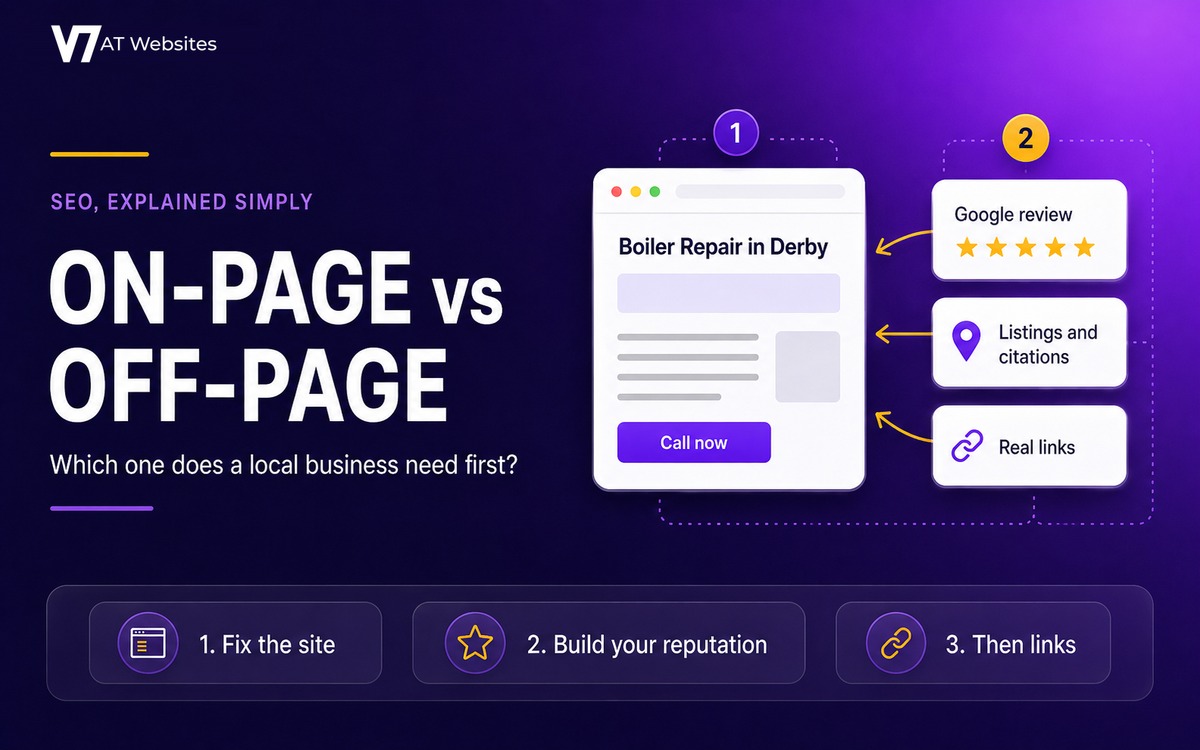
On-page SEO is everything on your own website. Off-page SEO is everything the rest of the web says about you. Fix on-page first so Google understands what you do and where, then build off-page so Google trusts you above the firm down the road. The other way round is where SEO money gets wasted.
Ask any owner of a service business what the difference between on-page and off-page SEO is and you'll get one of two answers. Either a shrug, or a slightly annoyed "does it matter? I just want the phone to ring."
Fair. The problem is that SEO people talk about on-page and off-page as if they're two products on a shelf and you're meant to pick one. They're not. They're two halves of the same job, and what matters is the order you do them in.
Get the order right and the money compounds. Get it backwards and you can spend a year paying for work that never lands. Most of the SEO horror stories we hear on calls are exactly that.
This isn't another explainer. We've already covered what on-page SEO is and what off-page SEO is. This one answers the question those two only touch: which do you do first, why, and how do you tell which one your website is missing?
The short answer
Do your on-page SEO first. Then your Google Business Profile and your listings. Then, and only then, worry about links.
On-page
Fix your own website first
Profile and listings
Google Business Profile, reviews, directories
Links
A few real ones, last
That's it. The rest of this post is why, and what each of those steps actually involves for a business that works in one town and a few around it.
On-page and off-page in one paragraph each
On-page SEO is everything on your own website: titles, headings, the words on each page, images, internal links, speed. If you can log in and change it, it's on-page. Its job is to make it obvious to Google what you do and where.
A plumber in Derby needs a page that says "plumber" and "Derby" where Google looks, one per service, and it needs to load fast on a phone.
Off-page SEO is everything on the rest of the web that says something about you: your Google Business Profile and its reviews, the directories listing your name, address and number, and links from other sites. You don't control it. You earn it.
Its job is to make Google trust you enough to rank you above the other plumbers in Derby whose sites also say "plumber" and "Derby".
On-page SEO
Your own website
- Page titles and headings
- A page per service and area
- The words on each page
- Images, and how fast it loads
- How pages link to each other
What you say about yourself. You control it directly.
Off-page SEO
The rest of the web
- Your Google Business Profile
- Google reviews
- Directory listings that match
- Links from other websites
- Mentions of your business elsewhere
What everyone else says about you. You earn it over time.
Here's how to hold the two in your head. On-page is the van: sign-written, clean, number on the side, tools in the back. Off-page is your reputation around town: the neighbour who recommends you, the reviews on Google, the number that matches on every card and listing.
A great reputation pointing at an unmarked van with no number on it gets you nowhere. Nobody can find you.
Why the order matters
Think of it as two questions Google asks about your business. What are you? And how much should I trust you? It struggles with the second until it has answered the first. That's a way of picturing it rather than how the algorithm works, but it holds up in practice.
Every off-page signal is a vote, and a vote works best when it's for something specific. A review that says "brilliant plumber, sorted our boiler in Derby" is a strong signal. It's far more useful when Google can connect your site with boiler repair in Derby, because there's a page about exactly that.
If your site has one page called "Services" with three sentences on it, the vote has little to attach to. Google files you under "vague local business" and a good review does a lot less for you than it should.
“Brilliant plumber, sorted our boiler in Derby.”
Clear site
Boiler Repair in Derby
The vote lands. Google connects the review, the page and the search.
Vague site
Services
Three sentences. No towns. No boilers.
Little to attach to. Google files you under “vague local business”.
There's a second reason, and it's money. On-page is mostly a fix: do it properly once, then keep it tidy when you add a service or an area. Off-page is ongoing, because reviews, listings and links build over months.
Paying for the ongoing thing while the one-off thing is still broken is the most common way we see a local business waste an SEO budget.
The order that works for a one-town service business
Here's the sequence we use, and the sequence you can follow yourself.
Your website
Fix the on-page basics
A unique title on every page with the service and the town in it. A real page for each service you want work for, with more than a few lines on it. The areas you cover mentioned naturally. Images compressed so it's quick on a phone. The on-page guide has a “what to fix first” list that takes an afternoon on most sites.
Your website
Build out the pages you're missing
Still on-page, and where most local sites are thin. Six services in eight towns is forty-eight different searches, and one “Services” page can't rank for all of them. When we rebuilt Goldswan Bathrooms the site went live with nine service pages and eleven area pages for exactly this reason.
Beyond your website
Sort your Google Business Profile
Now you move beyond your website. Claim the profile, complete every section, add photos, pick the right categories, and ask every happy customer for a review. The biggest lever a local business has outside its own site, and it costs nothing. Never been in the map pack? This is how.
Beyond your website
Make your listings match
The same name, address and phone number on Yell, Cylex, FreeIndex, Bing Places and the trade directories for your industry. Boring, one-off, and Google leans on it to confirm you're a real business operating where you say you are.
Beyond your website
Then links
A handful of genuine links from suppliers, local news, trade bodies and real businesses in your area. Slowly. This is the part the cold emails want to sell you first, and the part that pays off last.
How to tell which one you're missing
You don't need a tool for this. Open Google on your phone, search for your main service and your town, and look at where you land. Then match what you see against these two.
It's an on-page problem if
Google can't tell what your site is for
- You're barely appearing, even on page five, for searches you'd expect to be in.
- The wrong pages rank: your homepage shows up for a search your kitchen page should own.
- Every page is called Home, About, Services or Contact, and none of them mention the towns you work in.
Fix Titles, a page per service and area, real content, speed. Reviews alone are unlikely to move this.
It's an off-page problem if
Google understands you, it just trusts the others more
- You're on page two or three for the right searches, behind firms with more Google reviews.
- Your service pages rank, but you're nowhere in the map pack, the box of three at the top.
- Your name, number or address are different on your website, your Google profile and the directories.
Fix Google Business Profile, steady reviews, matching listings, then a few real links.
Both?
Fix on-page first. Then build the reputation that points at it.
If it's both, which is common, the order above still holds. Fix the site, then build the reputation around it. On-page tweaks won't move an off-page problem, and reviews alone are unlikely to rescue a site Google can't make sense of.
Where "local SEO" fits into this
You'll hear a third term thrown around, and it confuses people. Local SEO isn't a third category. It's the goal, showing up for people near you, and it uses both sides to get there. Area pages and town names in your copy are on-page. Your Google Business Profile, reviews and listings are the side beyond your website.
On-page
Area pages. Town names in the copy. A page per service.
Local SEO
The goal: showing up for people near you. It uses both sides.
Beyond your website
Google Business Profile. Reviews. Listings that match.
If someone sells you “local SEO” without touching your website, ask which half they've left out.
We've written up local SEO versus traditional SEO if the distinction is still fuzzy.
What we do
We run the two as separate services because they're different kinds of work, needed at different times. On-page SEO is built into every website we make: keyword mapping, titles, page structure, schema, internal links and speed, done before launch.
Off-page SEO is the monthly work after: citations, a review system that asks customers automatically, content worth linking to, and a few real links earned over time.
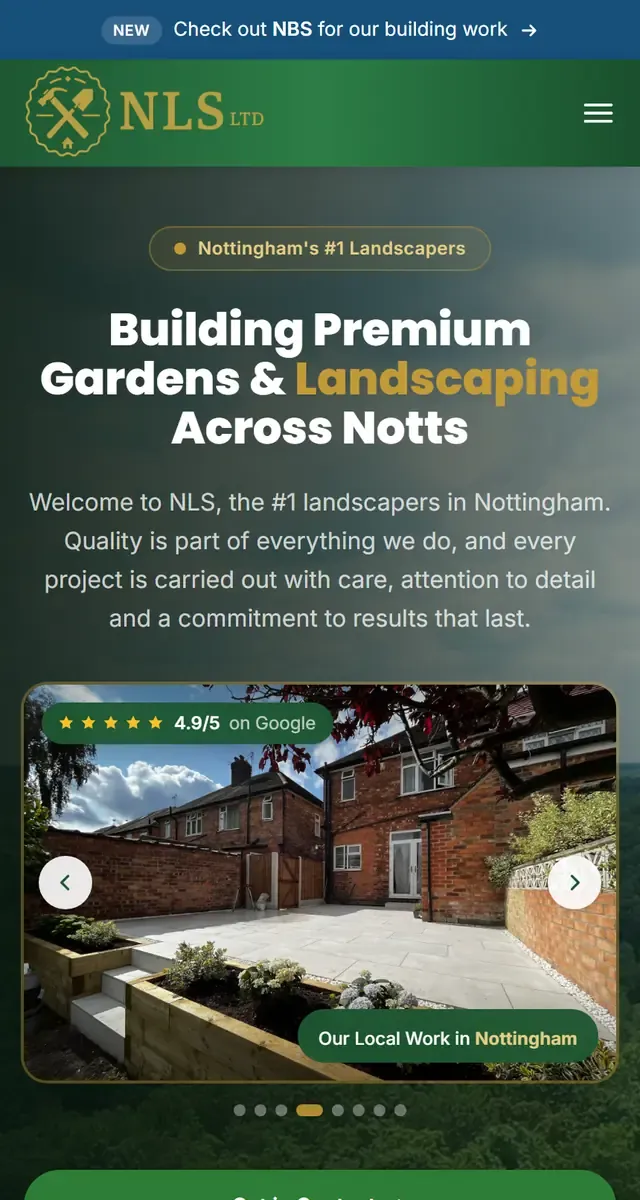
The order isn't a theory we like. It's what took Nottingham Landscaping Services from a broken website to 550+ direct enquiries: site rebuilt and structured first, then reviews, listings and content multiplying on top. We judge both halves on impressions and enquiries, and here's how SEO is actually measured if those numbers are new to you.
Want us to do both?
That's how we work with a business that's serious about search. Build or fix the website so the on-page side is right from day one, then run the monthly off-page work on top, reported in enquiries rather than rankings. Want to see what that looks like for your business? Book a free call and we'll map it out.
The honest summary
On-page tells Google what you are. Off-page tells Google how much to trust you. Do the first one first, because trust pointed at a site Google doesn't understand mostly goes to waste.
For a local service business that means: fix the pages, build the ones you're missing, sort your Google Business Profile, make your listings match, then earn a few real links.
Most of your competitors have done none of it properly. You don't have to do all of it. Just do it in that order.
Frequently asked questions
What is the difference between on-page and off-page SEO?
On-page SEO is everything on your own website that you can log in and change: page titles, headings, written content, images, internal links and speed. Off-page SEO is everything on the rest of the web that shapes how Google sees you: your Google Business Profile, reviews, directory listings and links from other sites. On-page you control directly. Off-page you earn.
What should a local business do first for SEO?
Fix the website first. Give every page a proper title with the service and the town in it, build a page for each service you want work for, and make sure the areas you cover are actually mentioned. Then complete your Google Business Profile and start asking for reviews. Links come last. That order gets most local businesses ahead of their competition before any money is spent.
Can you do off-page SEO without on-page SEO?
You can, and plenty of businesses pay for it, but it tends to underperform. Reviews, listings and links are votes, and a vote works best when Google can connect it to a page that clearly covers that service in that area. Point them at a website Google struggles to understand and much of the effort is wasted. Do the on-page work first, then the off-page work has something to build on.
How long does on-page SEO take to work?
Google usually recrawls a small business website within days to a few weeks, so changes get picked up fairly quickly. Ranking movement tends to follow over one to three months depending on how competitive your area is. Fixing a broken title or a thin service page can move things faster than people expect; off-page work is the slower, compounding side.
Are Google reviews on-page or off-page SEO?
Off-page, along with the rest of your Google Business Profile, because they live on Google's platform rather than your website. In practice reviews and the profile are the most valuable off-page asset a local business has, because they feed the map pack. Treat them as the first job once your on-page basics are sorted.
Do backlinks matter for local businesses?
Yes, but less than the cold emails suggest, and later than most people think. For a business working in one town, a complete Google Business Profile, steady reviews and matching directory listings usually do more than links. A handful of genuine links from suppliers, local news or trade bodies helps once those are in place. Buying links by the hundred does nothing useful and can get a site penalised.
How do I know whether my website's problem is on-page or off-page?
Search for your main service plus your town. If you don't appear at all, or your pages appear for the wrong things, that points to on-page: Google is struggling to work out what the site is for. If you appear on page two or three behind firms with more reviews and more listings, your on-page is doing its job and off-page is what's missing.
Do I need to pay for both on-page and off-page SEO?
Not at the same time, and not always both. On-page is mostly a one-off fix with occasional upkeep. Off-page is ongoing because reviews, listings and links build over months. Plenty of local businesses get the on-page done properly, do the free off-page work themselves, and only pay for off-page help once they're competing in a busier market.
Find out what's holding your rankings back. Run your website through our free audit and in a couple of minutes you'll see whether the on-page side is the problem, and what we'd fix first. If the site comes back clean and you're still stuck on page two, that's your answer as well: the work is off-page, and a free call is the quickest way to plan it. Get my free SEO review.