On this page
Almost every first conversation we have with a service business includes some version of "websites are too expensive." Underneath it sits the idea that causes it: that a website is one product with one price.
It isn't. "A website" covers everything from a page a teenager can knock together in ten minutes to a custom coded system that took hundreds of hours of skilled work. That's why quotes for "the same thing" can be £300 apart or £5,000 apart.
You already price work exactly like this
When a customer rings you, you don't quote "plumbing". You ask what needs doing. A leaky tap is one price. A full bathroom refit is another thing entirely, and nobody calls the plumber a rip-off because the refit costs more than a washer. The job sets the price.
Websites are priced the same way. The problem is that almost nobody itemises the quote, so "a website" sounds like one item and every number gets compared against every other as if they were pricing the same work. They almost never are.
What's actually on a website quote
These are the variables that move the number.
The build itself
- DIY builder site. Wix, Squarespace or an AI builder. You do the work, and it looks like it. Around £10 to £30 a month, plus your evenings, forever.
- Templated site, set up for you. A pre-made theme with your logo, photos and words dropped in. Typically £150 to £800 one-off.
- Custom coded website. Designed for your business and written in real code, no page builder underneath. Skilled labour, priced like it: typically £2,000 to £6,000+ in the UK.
The pages
Most quotes are page counts in disguise. A service page for every job, a location page for every town you cover, product pages if you sell things: each is its own chunk of design, copy and on-page SEO (here's how on-page and off-page SEO fit together).
A 5-page brochure site and a 25-page site are very different projects. If a quote doesn't list its pages, ask.
The systems
- Edit it yourself (a CMS). A login where you upload finished jobs and change copy without ringing anyone. Adds hundreds to low thousands to a build.
- Automated emails. Enquiry confirmations, quote follow-ups, review requests that send themselves. Often bundled, or £10 to £50 a month as standalone tools.
- Performance tracking. Knowing which calls and enquiries the site produced, not guessing. The tools are free; the skilled setup time isn't.
- Bespoke systems. Booking engines, quoting tools, project galleries, client portals. Custom development priced by scope, and where budgets climb fast.
The ongoing work
Being found on Google isn't a feature you buy once. It's monthly work: content, rankings, technical upkeep, tracking. For local service businesses this typically runs £400 to £2,000 a month in the UK. We've broken that down in our guide to what SEO costs.
Run down that list with your own business in mind. Do you want emails chasing your quotes while you're on the tools? A backend that tells you which jobs came from the site? Content every month so Google keeps sending people your way? Or just a tidy page that proves you're real?
Every yes moves the price. None of the yeses are compulsory. Price the list of work, not the word "website".
The three quotes that confuse everyone
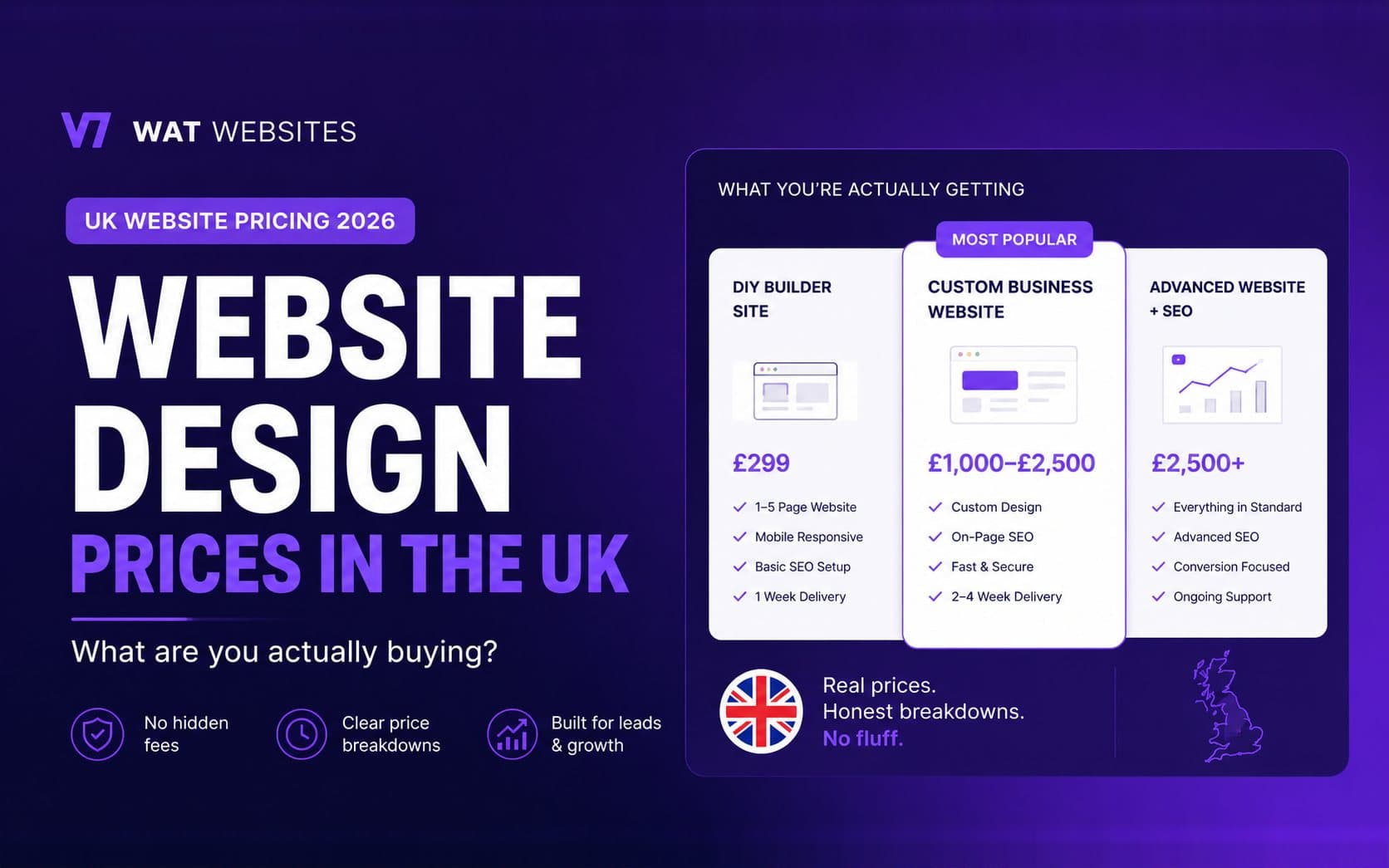
Most of the confusion comes down to three different products that all get called "a website". Side by side, the mystery disappears.
None of these is a con. They're different jobs. The trouble starts when they get mixed up: paying custom money for what turns out to be a template, or buying a template and expecting it to do the job of a full SEO project.
The first is being overcharged. The second is being under-sold. Both end with "websites don't work", and neither was the website's fault. If that second one sounds familiar, we've written about whether a website is worth it for exactly that situation.
Do these results look like a £200 website?
This is where we show our own work, because the numbers make the point better than we can.
NLS is the long-run proof. Aaron had already paid another designer for a website that ended up abandoned, a domain pointing at an error page. We rebuilt it properly, sorted his Google Business Profile, and kept improving both.
Sixteen months on, that's over 550 direct enquiries on jobs averaging around £5,000, and his team has grown from 2 to 12 on the back of it. He doesn't chase work any more. It finds him. That's the difference between buying a launch and buying a pipeline.

NLS's homepage today. The same domain used to point at an error page.
Coppermill Landscapes started from zero and took 52 direct enquiries in nine months without a penny of ad spend.

Coppermill's homepage, built from zero alongside the SEO that feeds it.
Batchelors Landscapes doesn't even run an SEO campaign: a site built to convert brought in 15 enquiries in under ten months, one of them a £40,000 commercial job.

Batchelors' site: no SEO campaign behind it, still converting on its own.
And CB Joinery, a Nottingham joiner just setting up on his own, landed his biggest job yet, worth over £1,000, within seven days of going live. Week-one results like that are rare and you shouldn't budget on one. But it shows what a properly built site does the moment the right person finds it.

CB Joinery's launch site. The call that mattered came inside week one.
None of that came off a £200 template. The rest of the receipts, including video reviews from these clients, are in our portfolio and on our reviews page.
Why one quote says £300 and another says £5,000
Because they're not quoting the same amount of human skill, and skill is what you're paying for.
At one end, an AI website builder will let a 14 year old stand up a passable site in ten minutes. Almost no skilled time goes in, so almost no money needs to come out.
At the other end, custom design and development is skilled labour billed like it. An experienced UK developer's time runs £100 to £200 or more an hour, the same way you charge properly for a skill that took years to build.
A custom coded site is real hours of that: research into what your customers search for, design decisions made for your business, and code written for the job.
Both are "a website" in conversation. On the invoice they have as much in common as an £80 tap swap and an £8,000 bathroom refit.
So when two quotes land miles apart, the question isn't "which one's ripping me off?". It's "which job is each of these quoting?" Ask each to itemise what's included. The one who won't break it down is the one to worry about.
The costs nobody puts on the quote
Whatever you buy, a few quiet costs sit around the edges.
- Your domain. The www address, around £10 to £15 a year from a registrar like GoDaddy. It should be registered in your name. If a provider insists on owning it, that's a red flag.
- Hosting. Every site lives on a server someone pays for. Basic hosting is a few pounds a month; managed hosting costs more because a human keeps the site fast, secure and backed up. Know which you're getting.
- Email. Professional email at your own domain is a few pounds per inbox per month, and worth every penny next to a Gmail address on the side of a van.
- The forever-subscription trap. DIY builders look cheap monthly, but the payments never stop and the site was never really yours. £25 a month forever is £300 a year for something you don't own.
- Your time. The "free" website you build yourself costs evenings and weekends, and it shows. Your hourly rate applies to you too.
How to buy the right website
Start where you'd start with your own customers: what needs doing?
If referrals and repeat work keep you busy and you just need to look legitimate when someone checks you out, buy small. A tidy, fast one-pager with your reviews, photos and a clear phone number does that job. Don't let anyone talk you into a £6,000 build for it.
If people find you but don't ring, the site is the weak link. That's a custom build job: making it obvious why you're the one to call, and making calling effortless. It's what our web design service is built around.
If you need people who've never heard of you, that's the full project: a proper site plus the monthly SEO work of being found. It costs the most because it's the only option that goes out and gets work, and the only one where you can measure exactly what came back.
If the honest answer is "I'm not ready to spend anything yet", then don't. We'd rather you had a decent page than no page, which is why we build one-page starter websites free. You buy your domain, it stays in your name, and the page is yours to keep.
Websites aren't too expensive. The wrong website is. A £7,000 lead system quoted against a "look legitimate" job feels obscene, and a £300 template doing a lead-generation job costs you every enquiry it never catches. Price the job, not the word.
Frequently Asked Questions
How much does a website cost for a small business in the UK?
There's no single number because there's no single product. A templated site set up for you is a few hundred pounds. A custom coded website typically runs £2,000 to £6,000 or more depending on the pages and features involved. That middle band is where the average cost of website design for a small business in the UK sits, though the average hides the spread, and the spread is the point. A full bespoke project with monthly SEO behind it usually lands at £5,000 to £10,000 plus upfront, then £400 to £2,000 a month for the ongoing work. Price the job you need doing, not "a website".
Why do website design quotes vary so much?
Because "a website" covers completely different amounts of skilled labour. An AI site builder can stand a page up in minutes with almost no skill involved. A custom coded build is a designer and developer's time, billed at £100 to £200 or more an hour at experienced UK studios. Two quotes that are thousands of pounds apart are usually quoting two different products, the same way a tap swap and a full bathroom refit leave the same plumber's van at very different prices.
Is a cheap website ever worth it?
Yes, when the job is small. If your work comes from referrals and repeat customers and you just need to look legitimate when someone checks you out, a simple, tidy page does that fine. Cheap goes wrong when you need the site to bring in leads. A template with no SEO behind it doesn't show up in search, so every enquiry it fails to catch is the real cost. If that's where you are, start with why websites fail to bring in leads before spending anything.
Do I have to pay monthly for a website?
Only for the parts that are properly ongoing. Hosting is monthly because the site has to live on a server somewhere. DIY builders charge monthly forever, and the site usually isn't yours if you stop paying. SEO and content are monthly because being found is continuous work, not a one-off task, and for local service businesses that typically runs £400 to £2,000 a month. The build itself can be a one-off cost, and with a decent provider the site and domain belong to you outright.
What is the difference between a template website and a custom coded website?
A template is a pre-made design that your name, colours and photos get dropped into, which is why it's cheap and fast, and why it looks like a hundred other businesses. A custom coded website is designed and built from scratch around your business: real code rather than a page builder, pages structured around how your customers search and choose, and the detail that gets someone to actually ring. The template's job is to exist. The custom site's job is to win the enquiry.
Still not sure what you actually need? That's the most normal place to be, and it's a ten minute conversation. We'll look at your business, tell you which of these you'd actually benefit from and which you can skip, and if the answer is "the free page and nothing else", that's what we'll say. Book a free call here.

Written by
Will Gadsby, Co-founder, WAT Websites
Will co-founds WAT Websites, where the team builds fast, custom websites and runs local SEO for UK service businesses, so their phone rings more often.